
Hey guys, this is a new blog dedicated to help students understand the 8th grade english curriculum here's a couple link's to a few helpful websites.
https://www.ixl.com/ela/grade-8
https://www.ixl.com/ela/grade-8

Understanding the Parts of Speech
- Noun: names a person place thing or idea
-Example: Johnny went to the market.
- Adjective: modifies a noun or a pronoun and answers these questions-What kind of? Which? How many? (Describing word)
-Example: The red car drove fast.
- Verb: expresses an action or a state of being
- Conjunction: joins words or groups of words
- Preposition: shows the relationship of a noun or a pronoun to some to some other word in a sentence (location/time)
- Article: a word used to modify a noun
- Interjection: expresses emotion and has no grammatical relation to the rest of the sentence
- Adverb: modifies a verb, an adjective, or another adverb (usually ends in -ly)
- Pronoun: used in place of one or more nouns
-Example: He hated them.

Active and Passive Voice
Active Voice is the subject doing the action.
Here are some examples of active voice:
- Marilyn mailed the letter.
- Marilyn(subject) is doing the mailing(verb)
- The man must have eaten five hamburgers.
- The man(subject) is doing the eating(verb)
Passive Voice is the subject being acted upon.
Here are some examples of passive voice.
- Five hamburgers are being eaten by the man.
- Hamburgers(subject) are being eaten(verb)
- The letter was mailed by Marilyn
- The letter(subject) was being mailed(verb)
Source: https://webapps.towson.edu/ows/activepass.htm

Essay Structure.
When you write an essay you will want to have an
introductory paragraph that will outline the reason for you writing this essay.
You will also want to get your readers attention by having a hook. A hook might
be a quote or a statement. Then you need to have a strong body. The body should be 2 or more paragraphs. The body should state the claim in each paragraph. Finally, you need a conclusion paragraph. The conclusion should restate the claim of the introduction paragraph.
Here is an example of an informational/explanatory essay by Utah Compose.
Here is an example of an informational/explanatory essay by Utah Compose.
Hello, my name is Walter Waters and I am here to teach you
about my kind. I am called a water droplet, just like you are called humans. We
droplets take up most of the earth, yes more than you silly humans. We take up
approximately 73 percent of the Earth’s area. That is about 326 billion
trillion gallons of water! 98 percent of this water is salt water and the rest
of the two percent is fresh water.
Now, you’re
probably wondering how I was made, I went through the process of hydrogen
bonding. Hydrogen bonding is when my mom, Hydrogen Two Waters bonded with my
dad, Oxygen One Waters to make me, Walter Polarity Waters. Or you can call me
H2O, like some of my other fellow droplets.
My parents
made Polarity my middle name because polarity is one of the unique properties
that we droplets have. Polarity means that we are unbalanced. This happens
because oxygen attracts more than hydrogen does, because oxygen has more of a
negative charge. Another thing Polarity does is that it makes us more attracted
to other polar substances like you humans or glass and other droplets. This
brings us to another property of water, adhesion and cohesion. Adhesion is when
water sticks to other things like glass and plastic. Whereas, cohesion is when
water sticks to water like inside this glass or on wax paper. Now, if you can
use your noggin, you would see that inside this glass are ice cubes and as you
may know ice is the solid state of water, but it still floats on water. This is
because of water’s density. The density of water in its liquid state is denser
than ice. This is because when ice’s molecules align it forms a pattern where
it leaves more space between molecules making it less dense, allowing it to
float on water.
One of the
cool things about water is its property of capillary action. Capillary action
is when water is able to climb up narrow spaces with adhesion and cohesion.
Like when water is able to climb up a straw when you put it in some water.
Capillary action also allows us droplets to be able to climb up a tree's roots
and water it!
Back to this
glass of water, if I wanted to put this sugar in this water to make sugar
water, the sugar would have to dissolve in the water. This process of the
solute, the sugar, dissolving in the solvent, the water, is called solubility.
Which is another amazing property of water called the Universal Solvent. Water
is the universal solvent because it can dissolve almost everything!
You might
have heard of this bug called the water strider, it claims that it can walk on
water, but the real truth behind this little bug is that we are doing all the
work! It is because of our property of surface tension that makes this even
possible. I mean who do they think they are? Saying that they are able to walk
on water, we are the hard workers, and we are the ones that hold these little
devils up above water . . . ugh! Sorry, I got a little carried away there . . .
back to teaching you about surface tension!
Surface
tension is when water appears to have an elastic film wrapped over it; this is
due to the bonds holding the water molecules together. But, if I put this straw
into the water, it breaks the surface tension.
Not only do
we do all of these phenomenal things, but we also control Earth’s climate. Yes,
Earth’s climate. The reason we can control Earth’s climate is because of our
property of specific heat. Specific heat is the amount of energy needed to
raise the temperature of one gram of a substance by one degree Celsius. The
reason water’s specific heat is so important is because it releases heat and
absorbs heat very slowly, which is why it can control the climate.
This brings us
to what I consider the coolest thing about water. This is the way it travels.
Yes, you travel in things called automobiles or vehicles, but we travel through
the water cycle. So if I started in the clouds and precipitation occurred I
would drop onto land and start to go down the mountains, in runoff. From here I
can go one of two ways, I can water a tree through capillary action, or I can
go into a stream, if I go into the stream I will then enter a lake, which
enters the ocean and I will then evaporate. After I evaporate I go up into the
air where condensation occurs, to form a cloud, where the cycle starts over
again. If I choose to water the tree, then I will transpire as water vapor,
condensation will occur, and I will form a cloud again.
So, I
hope you had as much fun as I did on our journey through the life of, well, me!
Source: Utah Compose

Verbal: a verbal is formed from a verb but acts as a different part of speech, a verbal is often part of a phrase.
- Types of verbals
- Gerund: a gerund ends in -ing and acts as a noun.
Example: Dancing like a ballerina is my goal.
- Infinitive: a participle is used with "to" plus a verb and acts as a noun, adverb, or adjective.
Example: To blow bubbles during class is a serious form of disrespect.
- Participle: a participle ends in -ing, -ed, or -en and acts as an adjective
Example: The basket, tattered and broken, was thrown out.
Source: Kim Kroll Teachers Pay Teachers
Text Structure
 |
| Cause and Effect
|
Example: Today, I had a great day due to three major reasons. Fist of all, I won tickets to the Super Bowl, then I won the lottery, and to top it all off, I became CEO of Apple Inc. However, the next day I was so excited that I broke my arm cutting a tree branch off a tree while I was sitting on it and had to use all my lottery money to fix my arm, and wasn't able to go to the Super Bowl, but I'm still CEO of Apple, for now.

Chronological Order: First, I woke up this morning and took a shower. Then, I got ready for the day and ate breakfast. After, i went to school and to all my classes (science, math, choir, english, gym, spanish, and history). When I got home, I got ready for lacrosse and went to practice. Then I got ready for basketball and went to a game.
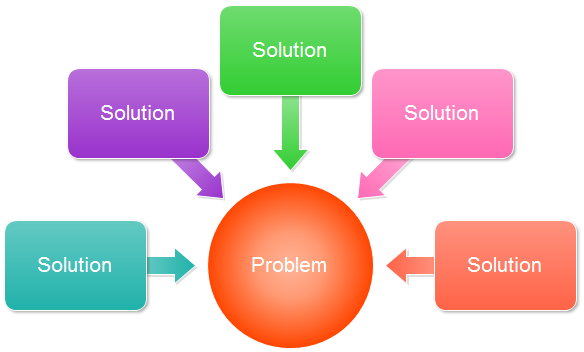
Problem and Solution: My problem today is I don't know what to write about. I need to think and maybe even look something up on the internet. Then, i will be able to complete my assignment.
This maybe not the best example but there will almost always be a solution to your problem, the key is learning how to find that solution and apply it to the problem.

Step by Step: There
are just a few easy steps too destroying an evil wizard emperor. First, you
need to get an army of crazy super warriors. Second, you need to show people you’re
crazy super warriors so they will join your cause. Third, you need to get
weapons that can destroy you enemy’s. Then you need to destroy all of the wizard’s
army. Last but not least you must destroy the evil wizard with your super
warriors and you beast weapons. That is how you destroy an evil wizard emperor.

This is looking really great! Thank you for remembering to cite your sources. Very impressive!
ReplyDeleteGreat! So helpful!
ReplyDeleteA couple corrections on your Parts of Speech section:
ReplyDeleteAdjectives - red is and adjective, but fast is an adverb
Verbs - is is the verb; running is a gerund
Thanks guys!